Design Nomenclature / Surface & Material
Albedo
Also called base color, basecolor, diffuse color, albedo map
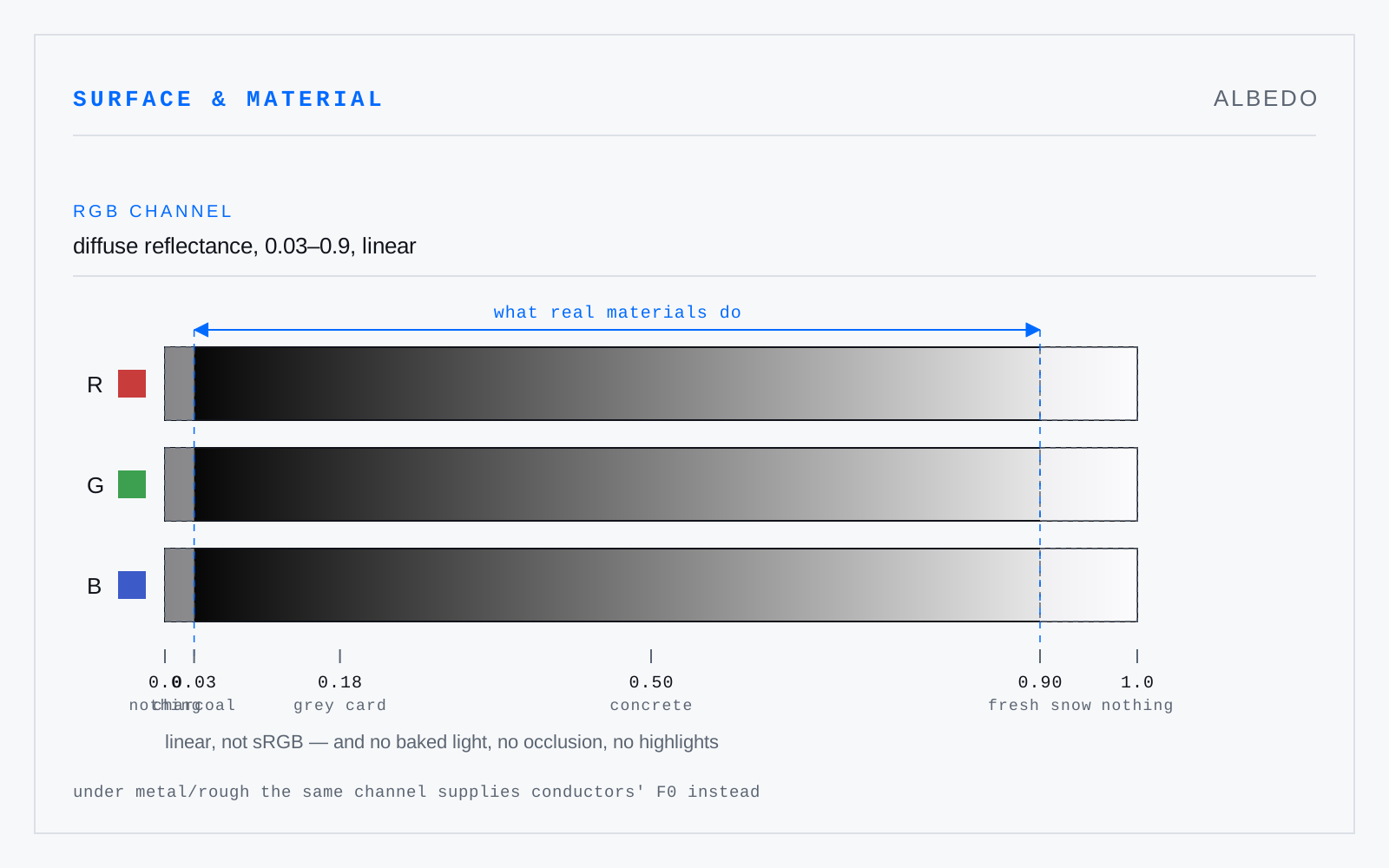
The fraction of incident light a surface returns by diffuse scattering, per wavelength band — the color light acquires after entering a dielectric, bouncing, and leaving. Bounded in practice: real materials rarely exceed 0.9 or fall below 0.03. Under metal/rough conventions the same channel supplies conductors' normal-incidence specular reflectance instead.
In practice
Said interchangeably of the value, the texture, and the channel. "Albedo" also implies the map is clean — no baked light, no occlusion, no highlights.
Not to be confused with
- Diffuse mapThe texture supplying a surface's diffuse response. In legacy spec/gloss pipelines it routinely carries baked lighting, ambient occlusion, and painted highlights; a true albedo map carries none of that, only the material's own reflectance. The difference is authoring discipline, not file format — the same PNG can be either.
- ValueHow light or dark a color is, independent of hue and chroma — the one attribute that survives conversion to greyscale. Value does the structural work: legibility, depth, and figure-ground separation all rest on value difference far more than on hue difference, and a composition that fails in greyscale was leaning on hue to hide it.
- LuminanceRadiance weighted by the eye's photopic sensitivity and integrated over wavelength — candela per square metre. It measures light leaving a surface toward the observer, is what a display's peak-brightness spec quotes, and is linear in energy, so equal steps in it are not equal steps in appearance.
Origin
Latin albedo, whiteness, from albus. Borrowed from astronomy, where it measures the fraction of sunlight a planetary body reflects.