Design Nomenclature / Light & Optics
Scattering
Also called Rayleigh scattering, Mie scattering, volumetric scattering
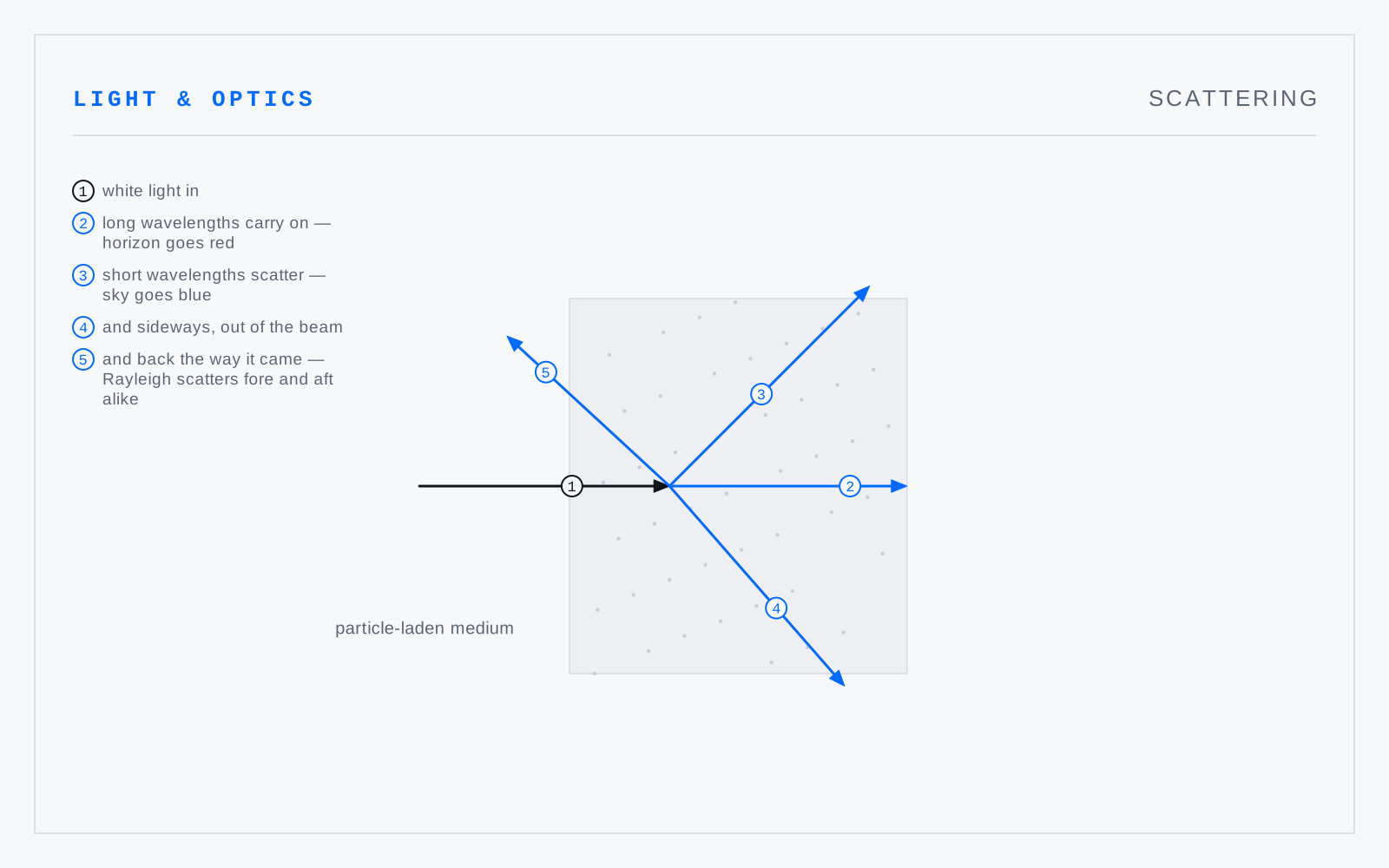
Light redirected out of its path by particles or inhomogeneities rather than by a smooth boundary. Rayleigh scatter, off things far smaller than the wavelength, is strongly wavelength-dependent and is why the sky is blue; Mie scatter, off things at or above it, is not, and is why cloud and milk are white.
In practice
One mechanism under subsurface scattering, atmospheric perspective, and haze — where it happens gives it the name, not what happens. The wavelength dependence is the part worth carrying: it explains why the same sky is blue overhead and red at the horizon, through more air.
Not to be confused with
- RefractionThe bending of light as it crosses between media of differing index, because its phase velocity changes; Snell's law fixes the new angle from the ratio of the two indices. It is what makes a submerged rod look broken and what gives a lens any power at all.
- DiffractionThe spreading and interference of light as it passes an edge or aperture — a wave effect rather than a ray one. It sets the resolution floor of any optical system, puts the star points on a stopped-down aperture, and produces the rainbow sheen on a disc's pitch.