Design Nomenclature / Form & Geometry
N-gon
Also called ngon, n gon, multi-sided face
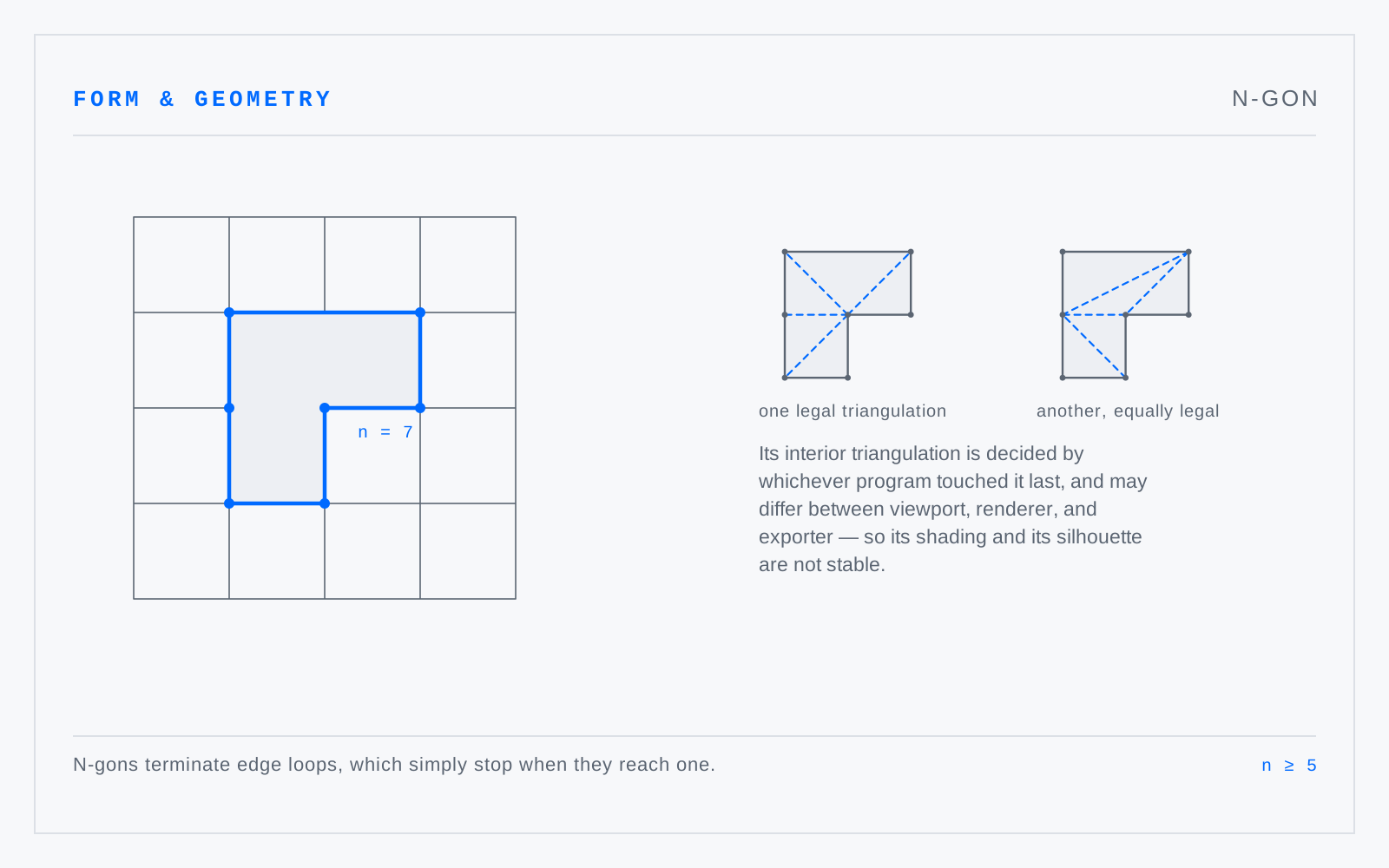
A face with five or more vertices. Legal geometry, but its interior triangulation is decided by whichever program touched it last and may differ between viewport, renderer, and exporter — so its shading and its silhouette are not stable. N-gons also terminate edge loops, which simply stop when they reach one.
In practice
Tolerable on a flat region that will never deform or subdivide, a defect anywhere that bends. CAD tessellation emits them constantly, which is why imported STEP looks perfect and deforms appallingly.
Not to be confused with
- QuadA four-vertex face. Quads carry two orthogonal edge directions, which is what makes loops and rings navigable; they subdivide predictably under Catmull–Clark and deform without a triangle fan's shading pinch. They are not planar by nature — any quad whose four points miss a common plane gets split into two triangles somewhere downstream, silently.
- TriA three-vertex face. Always planar, never ambiguous, and the only primitive a GPU actually rasterizes — every other face type is triangulated before it is drawn. In a subdivision cage a triangle produces a three-valence pole and a small curvature dimple under Catmull–Clark, which is the real reason modelers avoid them.