Design Nomenclature / Digital Model Making
Sculpting
Also called digital sculpting, brush modeling
Pushing a very dense surface with brushes rather than editing vertices one at a time — the mesh is a medium, not a structure. Detail is bounded by local density, so the tool must either add topology under the brush or start from a mesh already dense enough to hold what you intend.
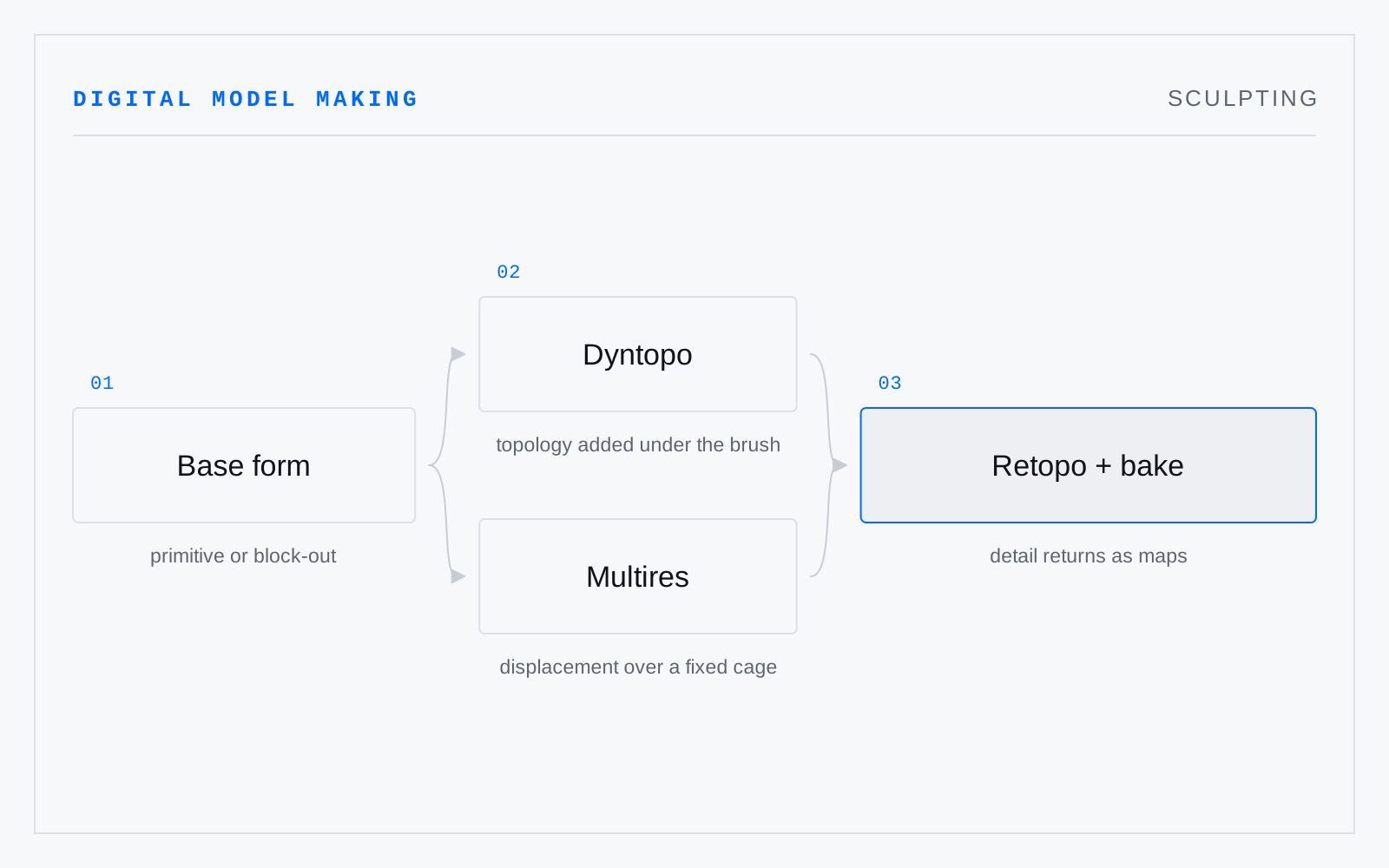
In practice
Two unrelated workflows share the word: dynamic topology retessellates as you go and destroys any layout; multiresolution sculpts displacement over a fixed cage and steps back down.
Not to be confused with
- Polygonal ModelingBuilding form from an explicit mesh of vertices, edges, and faces, moved and cut by hand. The mesh is the final surface, so its resolution is decided up front — a cylinder is faceted at whatever segment count you gave it. Fast, direct, and indifferent to mathematical exactness.
- Voxel ModelingWorking on a regular 3D grid of samples, each cell occupied or carrying a value. Topology changes are trivial — you are editing an array, so self-intersection is not expressible — but resolution is fixed and isotropic, memory scales cubically, and every surface must be extracted by an isosurface pass that leaves a grid signature.
- RetopologyBuilding a new, deliberately laid-out mesh over an existing surface, by hand or with guided automation. The goal is not fewer polygons; it is edge flow that deforms correctly, loops that follow the anatomy or the feature lines, and a quad-dominant cage that subdivides cleanly. Detail returns by baking.